Sepak Takraw and Volleyball: Two Nets, Different Ways to Keep the Ball Moving
Sepak takraw and volleyball use a net in sharply different ways; learn how each game’s rules shape movement, teamwork, and the rhythm of a rally.
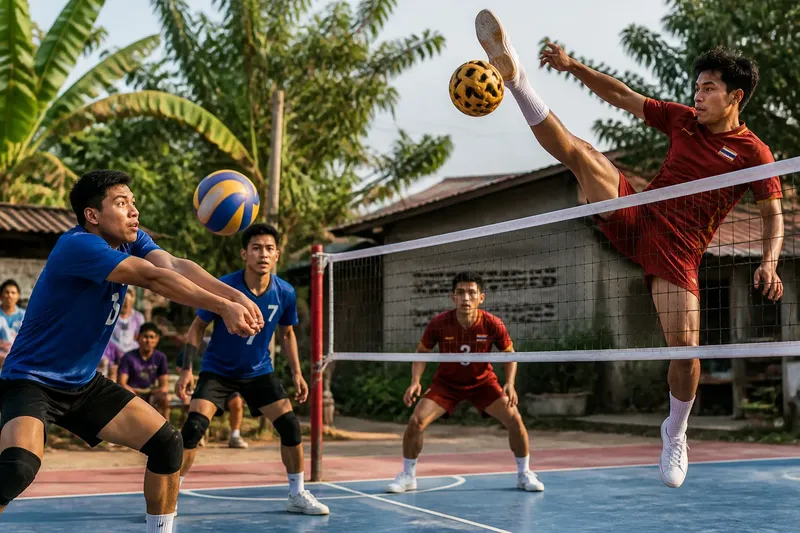
At a neighborhood court, a volleyball can rise from a forearm pass while a sepak takraw ball arcs away from a player’s foot. Both rallies cross a net, but the resemblance ends quickly: volleyball organizes contact around the hands and arms, while sepak takraw makes the body below the shoulder its principal toolkit. Understanding that difference makes each game easier to watch—and harder to mistake for a variation of the other.
In volleyball, the net is an obstacle and a boundary: teams send the ball over it, then build a chance to return it before it touches the floor. In sepak takraw, the net divides the court too, but the ball is played with feet, knees, chest, and head rather than hands or arms. Each sport gives players a distinct problem to solve, and the ball’s movement reflects that choice.
Volleyball uses the net to organize a team’s sequence
A familiar volleyball rally often has a recognizable shape. One player receives the opponent’s serve or attack, a teammate sets the ball, and another sends it across the net. The team can use fewer contacts, but the three-touch pattern is a common organizing idea: receive, prepare, attack. Each contact gives the next player a clearer or more difficult task.
The first touch is often made with the forearms held together, a technique commonly called a bump or forearm pass. It is meant to control the ball’s direction and height, not simply knock it back. The setter then uses the hands to place a ball where an attacker can reach it. A spike sends the ball down or through a gap; a tip may instead drop it into open court.
That sequence explains why the volleyball net shapes both attack and defense. Attackers look for a line past or around blockers, while defenders position themselves to cover likely angles and short drops. A block can stop a ball at the net or slow it enough for a teammate to dig it up. A dig is a defensive save, usually made low, that keeps the rally alive and gives the team another chance to build an attack.
The hands and arms make controlled placement central to volleyball. The ball can be guided upward with a set or redirected with a forearm pass, so teams can arrange a planned third contact. Timing matters, but so does the quality of the earlier touch: a pass that drifts too close to the net can leave the setter with few options.
For a viewer, follow the ball’s first contact after it crosses the net. If a player controls it rather than hitting it straight back, the team is likely trying to turn defense into a constructed attack.
Sepak takraw turns the net into an aerial target
Sepak takraw is often introduced through its dramatic kicks, but the game is not simply about making the highest or flashiest strike. Players keep a woven ball in play using permitted body parts below the shoulder, including the feet, legs, torso, and head. Hands and arms are not used to play the ball. The aim is to send it over the net so the opposing side cannot make a legal return.
That restriction changes how a team prepares its next touch. A player may cushion the ball with a foot or thigh, set it upward, then let a teammate attempt a forceful kick over the net. The three-contact limit encourages cooperation, but the contacts do not resemble volleyball’s hands-and-arms sequence. Each player must manage the ball with a smaller set of contact surfaces, often while balancing or moving into position.
The net is therefore an aerial target as well as a dividing line. A server sends the ball across, and an attacking player may jump and strike it with a scissor-like or overhead motion. The opponent’s challenge is to read the trajectory, get underneath the ball, and control it with a legal body contact before it falls or travels out of reach.
When watching, notice how a player’s first touch changes the height and angle available to the next teammate. A controlled lift can create time for an attack; a hurried touch may leave the ball too low or too close to the net. The most striking kick may finish the sequence, but the quieter setup touch often makes it possible.
The same rally goal demands different kinds of control
Both sports reward teams for preventing the ball from hitting the floor on their side, yet their idea of control differs. Volleyball gives players their hands and arms for receiving, setting, blocking, and striking. The challenge is to shape those contacts into a useful sequence while anticipating the opponent’s response.
Sepak takraw asks players to control the ball without hands or arms. The foot can send it sharply, but it can also cushion or lift it; the thigh and chest may help stabilize a difficult arrival. Players need body awareness and balance because a touch that works in volleyball—reaching out with a hand—would be illegal in sepak takraw.
Those rules also influence what a team can do under pressure. In volleyball, a player may use a forearm pass to direct a fast ball toward a setter. In sepak takraw, a player might use a foot or another legal body part to lift a ball, then depend on a teammate to complete the next touch. Neither approach is a lesser version of the other. The contact rules create different skills and tactical choices.
Imagine a beginner watching both sports from beside a court. They see a volleyball player meet a low ball with joined forearms, then see a sepak takraw player raise a low ball with the inside of a foot. In each invented situation, the action is meant to keep the rally going; the observable result is a playable ball for a teammate, achieved through a different legal tool.
Rally rhythm comes from the contact rules
Volleyball often has a visible build-up: pass, set, attack. That rhythm is not automatic, and a team may return the ball with its first or second contact if the situation calls for it. Still, the three-touch idea gives spectators a useful way to anticipate whether a team is preparing a strike or scrambling to survive.
Sepak takraw can also develop through several touches, but the ball’s path and the need to use the body rather than the hands make the sequence feel different. A player’s lift may send the ball into a high arc for a teammate’s kick. A fast attack can follow, or the receiving team may return a controlled ball and reset the exchange. The rally’s pace depends on how cleanly each side can position itself beneath the ball.
In both games, a team must decide whether to prioritize safety or pressure. A controlled return may give the opposing side time to organize, while a sharp attack can force a hurried response. Volleyball teams may use a tip or a deep hit to exploit space; sepak takraw players may vary the direction and angle of a kick. The strategic question is similar—where is the opponent vulnerable?—but the ways to answer it follow each sport’s permitted contacts.
To read a rally, watch the defenders as closely as the attacker. Their spacing reveals what kind of return they expect and whether they are protecting the open court or preparing to cover a block or kick.
What should a new viewer notice first?
Can a volleyball player touch the ball with the feet?
Modern volleyball rules permit contact with different parts of the body, including the feet, provided the play otherwise meets the rules. In ordinary rallies, hands and arms remain the most recognizable tools for receiving and setting, so a foot save stands out.
Can a sepak takraw player use a hand to keep the rally alive?
No: hands and arms are excluded from legal play. Look instead for contact with the foot, leg, torso, or head, and notice how players arrange their bodies to make a controlled return.
Do both sports follow the same three-touch pattern?
Both commonly allow a team up to three contacts before returning the ball, but the pattern is not identical in practice. Volleyball often uses a pass, set, and attack, while sepak takraw builds its attack through legal body contacts that may include a lift and a kick.
What does the net mean in each game?
In both sports, it separates the teams and marks the route the ball must cross. Volleyball teams often use it as a blocking line and an attacking reference, while sepak takraw players also treat it as the height and angle to clear with a kicked ball.
Choose what to follow during a first match
A first-time viewer does not need to learn every fault or formation before enjoying a rally. Start with the ball’s contact surface and ask what the player is trying to set up. In volleyball, look for the pass that feeds a setter and the attack that follows. In sepak takraw, track how a legal touch lifts the ball into reach for a teammate’s kick.
Then watch the net-side players. A volleyball blocker may jump to narrow the attacker’s options, while backcourt defenders prepare for a ball that slips past or rebounds off the block. In sepak takraw, the opposing players read the kicker’s approach and adjust to the likely direction of the strike. Their stance and spacing can tell you what they expect before the ball crosses.
It also helps to notice how each team responds to an imperfect contact. Volleyball players may send a high, conservative ball back to recover their shape. Sepak takraw players may use a careful foot or thigh contact to keep the ball available for another teammate. In either case, a rally can survive without a perfect setup; the difference is how players regain control.
Rules and details can vary by competition, so a venue’s explanation or the governing body’s current rules are useful if a specific call is unclear. For a casual comparison, though, the central distinction is easy to see: volleyball gives players hands and arms to build a controlled sequence across the net, while sepak takraw asks them to keep that sequence alive with other parts of the body.
That contrast is the simplest way to remember sepak takraw and volleyball: two nets, two contact languages, and two distinct routes from a difficult ball to a teammate’s next chance. Once you can identify the touch, the rest of the rally becomes easier to read—and each sport’s ingenuity becomes more apparent.