How a Sumo Tournament Moves from Opening Ritual to Final Bout
Follow a sumo tournament from ring ceremony to final bout, with clear cues for reading the daily schedule, pre-bout rituals, and results.
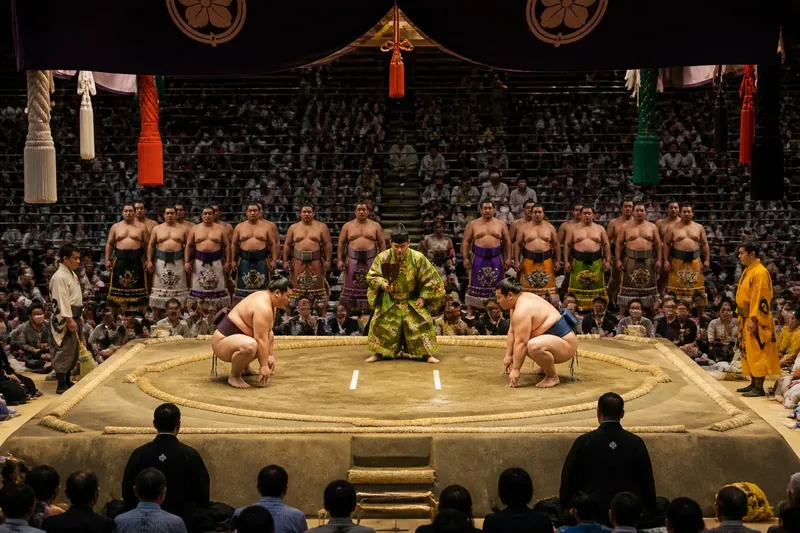
You settle into your seat as attendants sweep the sumo ring, and the room’s attention gathers around the raised clay platform. A sumo tournament becomes easier to follow when you can distinguish its ceremonies, division schedule, pre-bout rituals, and the contests themselves.
The ring and its boundaries set the terms
The ring, called the dohyō, is a raised platform topped with packed clay. Straw bales mark the contest circle. A wrestler loses by touching the ground outside that circle with any body part other than the soles of the feet, or by touching the ground inside it with a body part other than the soles of the feet.
Before the bouts begin, the ring receives attention of its own. A senior referee enters during the opening ceremony, and wrestlers from the top division appear in a formal procession. Their measured movement and ceremonial clothing distinguish this presentation from the bouts that follow.
The ceremony is not a match and does not affect the tournament result. It marks a transition into the day’s competitive schedule, which proceeds through bouts in sequence.
The daily schedule moves through divisions
A tournament day includes wrestlers from several divisions, with lower divisions generally appearing before the top division. The event schedule gives the order; announcements or a printed program can help you see which division is currently competing.
Each bout pairs two wrestlers. They enter from opposite sides, step onto the ring, and perform familiar preparatory gestures such as crouching, clapping, and stamping. These actions belong to sumo’s ritual language. Facing an opponent or moving toward the center does not, by itself, mean the bout has started.
The gyōji, or referee, takes position between the wrestlers and calls them to the start. They must both be ready and make their simultaneous charge from the starting position; if they are not ready, they may reset and try again. The charge after both wrestlers have settled and the referee has called them to begin is the start of the bout—not a warm-up gesture or an earlier reset.
Pre-bout rituals give wrestlers time to prepare
Some gestures can look like a delay if you do not know what to watch for. Wrestlers may throw salt into the ring, rinse their mouths, or return to their corners. Salt is associated with purification of the ring, while the repeated preparation gives each wrestler time to settle and choose an opening approach.
Keep the sequence in mind: preparation, a call to begin, then the charge when both wrestlers are ready. If either wrestler rises before that charge, the bout has not begun; watch for the next shared start rather than guessing from a single movement.
Imagine you arrive just as two wrestlers return to their corners after crouching. Neither has charged, so you have not missed the contest. They repeat their preparation, settle at the starting position, respond to the referee’s call with a simultaneous charge, and begin the bout.
Balance and boundaries determine the result
Once the bout begins, wrestlers try to force an opponent out of the circle or down onto the clay. They use pushes, belt grips, shifts in balance, and changes of direction. A bout may end quickly, and a small adjustment of footing can matter as much as a dramatic throw.
The referee signals an apparent winner, but judges around the ring can call for a review if the result is uncertain. They may confer and decide whether the initial call stands or the bout must be repeated. Keep watching after an apparent finish: the officials’ decision settles the result.
You do not need to memorize named techniques to follow the action. Ask what ended the bout: did a wrestler leave the circle, touch the clay with a body part other than the soles of the feet, or lose balance and fall? Those visible outcomes make the basic result easier to read.
The top division brings the day toward its close
After earlier divisions, the top division takes its turn. Its wrestlers appear in a ring-entering ceremony, presenting themselves in a formal display. The ceremony is separate from the bouts, but it signals that the day has reached its featured stage.
As the top-division bouts proceed, the schedule generally brings higher-ranked competitors toward its end. The final bout closes that day’s schedule; it is not necessarily the tournament’s overall championship match. A division winner is determined by results across the tournament and the applicable rules for settling a tie.
Say you are following a wrestler scheduled late in the top division. You see the ring-entering ceremony, then several pairings before that wrestler appears. The bout’s result becomes part of the tournament record, and the remaining scheduled contests still take place before the day ends.
What should you watch for during a sumo tournament?
Does the opening ceremony count as a match?
No. It presents the ring and featured wrestlers but does not add a win or loss to anyone’s record. Treat it as a sign that the competitive schedule is approaching.
When has a bout actually started?
The referee calls the wrestlers to begin, but the bout starts with their shared charge from the starting position once both are ready. Earlier crouches, rituals, and resets are preparation, not the contest.
What decides who wins a bout?
A wrestler wins by making the opponent touch the ground with a body part other than the soles of the feet, or by forcing the opponent out of the circle. If officials question the call, their review resolves it.
Is the last bout the tournament championship?
It is the final contest on that day’s schedule, not automatically the tournament’s overall title bout. The tournament result depends on records across the event and the rules for settling any tie.
Use the schedule to keep your place
Notice the transitions: the opening ring ceremony, the progression through divisions, the top-division procession, and the final scheduled bout. Within each contest, distinguish preparation from the shared charge, then watch for the referee’s call and any review.
If you step away or arrive during a ceremony, check the program or listen for the division announcement. That small cue tells you where the day stands and helps you reconnect without needing to track every wrestler or technique.