How Japan’s School Sports Day Became a Festival of the School Year
Japan’s school sports day grew from organized physical education into a school festival. See how its routines, public displays, and local adaptations took shape.
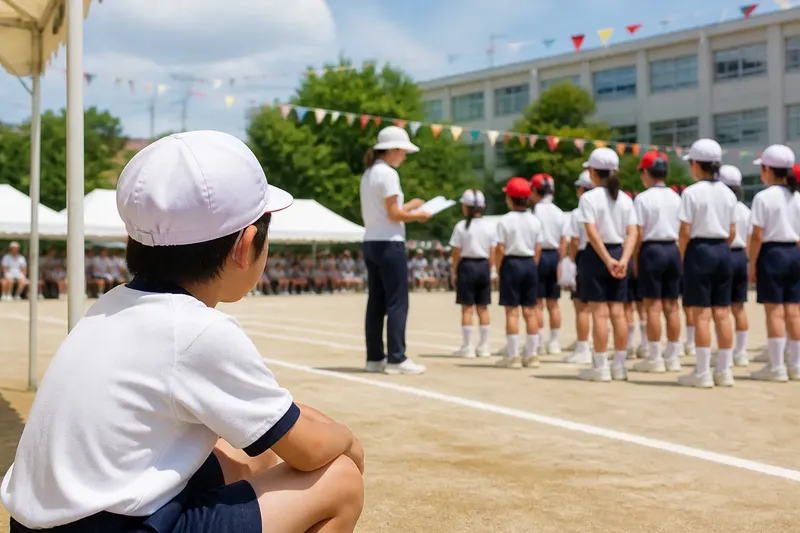
A child in a white cap waits beside the field as classmates line up and a teacher checks the event order. Japan’s school sports day, often called undōkai, gathers scenes like these into a public school event. Its history is not one simple origin story: physical education, school ceremonies, and local choices all helped shape the tradition.
One useful historical anchor is the Meiji era, when Japan’s modern school system and formal physical education were developing. In 1874, a physical exercise meeting at the Naval Academy in Tsukiji is commonly cited in accounts of early Japanese sports days. That gathering was not identical to a present-day school festival, but it offers a concrete starting point for understanding how organized exercise became a public event.
Japan’s school sports day took shape alongside modern physical education
During the Meiji period, schools increasingly treated physical education as part of organized schooling. Exercises and contests could bring students together under a planned program, while an audience made the activities visible beyond the classroom. The 1874 gathering at the Naval Academy is often described as an early precedent; it should not be mistaken for proof that every school sports day descends from one event in a straight line.
As schools adopted physical activities, formats varied. A gathering might feature coordinated drills, races, or other contests, depending on its organizers and setting. The important development was the public program itself: movement was arranged as an occasion where students took part and spectators could watch.
That distinction helps explain how sports day could grow into a school tradition without having a single uniform blueprint. Schools adapted the idea to their students, grounds, calendars, and educational priorities.
Public displays made exercise part of school identity
Early public programs could emphasize discipline, fitness, and coordinated group activity. A set of exercises performed together presented more than individual athletic ability; it showed students responding to instructions and working in unison. Races and contests, by contrast, made individual effort and friendly rivalry easier to see.
The event’s visible structure mattered. Lines, team colors, signals, and a sequence of activities helped spectators follow what was happening on the field. These details also made the school’s organization apparent: teachers directed the program, students took on roles, and families could witness a planned piece of school life.
Imagine a school arranging a modest outdoor gathering with class exercises and short races. If families are invited to watch, the same activities become a public presentation as well as physical practice; the observable change is that students perform within a shared event rather than only during an ordinary lesson.
The annual calendar turned a gathering into a tradition
A recurring place in the school calendar helped sports day become something students and families could anticipate. Teachers could prepare the program, students could practice routines, and families could plan to attend. Repetition also let customs pass from older students to younger ones, even as particular events changed.
Preparation often reaches beyond the day itself. A class may rehearse a dance, practice relay handoffs, paint team signs, or assign students to carry a flag. Those tasks give children different ways to contribute and make the event a shared stretch of school life rather than a single performance.
For a new student, joining a rehearsal can reveal the school’s customs before the festival arrives. Learning a team color or helping with a class sign makes the event’s social structure easier to understand.
Family attendance connected the field with neighborhood life
When families came to watch, the school field also became a meeting place. Parents could cheer for children, relatives could greet one another, and students could perform for people they knew. In some schools, families shared food during the day; the arrangements varied according to school rules and local practice.
This public role was not the same everywhere. A school’s grounds, local weather, family schedules, and the size of its community could shape who attended and how the program was arranged. The tradition remained recognizable without every school staging an identical festival.
For visitors, it helps to distinguish the general tradition from a particular school’s choices. An outdoor field, a family lunch, or a group performance may be familiar features, but none alone defines every undōkai.
Schools adapted the program without discarding its shared purpose
Over time, schools adjusted activities and schedules to fit their students and circumstances. A program might include running races, relays, group performances, or activities suited to younger children. Schools could also change the sequence or use an indoor space when conditions required it.
These changes show why the tradition is more than a fixed list of contests. A school can preserve shared preparation, visible team identities, and a family audience while changing which activities work for its community. Watching how the program groups activities can also reveal its emphasis: a race highlights individual effort, while a coordinated performance foregrounds practice as a class.
Say a school has a small field and a class preparing both a relay and a group dance. Organizers place the relay on the field and schedule the dance in a covered space if weather makes the ground unsuitable. The resulting program keeps both kinds of participation while adapting the setting to the day’s conditions.
What do visitors often want to know about Japan’s school sports day?
Why do students wear team colors?
Team colors make class or house affiliations easier to recognize from the sidelines. They also give students a visible group identity during individual contests and shared performances.
Why are group performances part of sports day?
Group performances let students show movements they have practiced together and coordinate with classmates. They can also offer a way to participate for children who are not taking part in a race.
Does every school hold sports day in the same season?
No single season applies to every school. The date depends on the school calendar and local conditions, so the event’s place in the year can differ.
Why do families bring food?
At some schools, sharing food is part of spending the day together between events. What families bring and where they eat depend on school arrangements and local custom.
Japan’s school sports day still reflects its layered history
The history of Japan’s school sports day connects formal physical education with public displays and recurring school gatherings. The 1874 Naval Academy event provides a commonly cited early reference point, while the varied programs schools developed show why the tradition should not be reduced to one origin or format.
When you attend an undōkai, notice who organizes each part as well as what happens on the field: students helping classmates, teachers guiding the sequence, and families watching from the sidelines. Those visible roles help explain how Japan’s school sports day remains part of the school year while allowing each school to shape its own event.