What a Kendo Match’s Points Do Not Tell You
Kendo match scoring makes more sense when you look beyond contact: learn how formal criteria guide judges and what to watch from the stands.
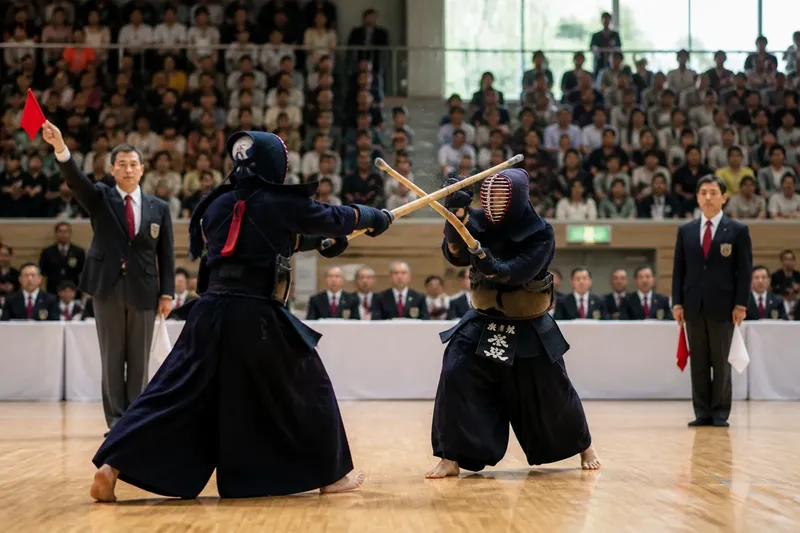
A shinai snaps against a helmet, the crowd reacts, and one judge’s flag rises while another stays down. Kendo match scoring asks spectators to look beyond the point of contact: a visible strike is only one part of the action judges assess.
That distinction can make a first match feel puzzling. A clean-looking hit may bring no point, while a brief exchange that seems less dramatic may be awarded. The difference is not simply whether the bamboo sword touched a target. Kendo’s formal criteria consider the target, the strike’s execution, the competitor’s spirit, and the continuation after contact. Those criteria guide trained officials; they are not a mechanical checklist spectators can apply from one angle.
A point belongs to a complete action, not just a touch
In a match, competitors wear protective armor and use a shinai, a bamboo practice sword. The recognized scoring areas include the head, wrists, trunk, and throat area. A strike must reach an appropriate target with the correct part of the shinai and meet the formal requirements for a valid strike, or yuko-datotsu.
Those requirements describe an integrated action, not a set of isolated boxes. Officials assess such elements as the target, the striking technique, the competitor’s posture and spirit, and zanshin—the continuation of alert readiness after the strike. These terms help explain what the rules ask judges to evaluate, but a spectator should not treat any one visible cue as decisive.
A sound, a visible swing, or an opponent’s reaction can offer clues, but none settles the question alone. A strike may reach a recognized target yet not satisfy the formal criteria for a point. A fast exchange can also contain important details that are difficult to see from the stands.
Target, execution, and continuation work together
It can help to watch an exchange through three broad lenses: where the strike lands, how it is delivered, and what follows. This is a viewing aid, not a substitute for the officials’ assessment of the formal criteria.
- Target: Notice whether the action appears directed at a recognized scoring area, such as the head, wrist, trunk, or throat area. If you cannot see the contact clearly, avoid deciding from the apparent target alone; follow the officials’ signals.
- Execution: Watch the movement of the shinai and the competitor’s control through the action. If the technique is obscured or too quick to judge, treat it as uncertain rather than assuming contact was sufficient.
- Continuation: Notice whether the competitor appears alert and ready after striking, a quality associated with zanshin. If the follow-through is hidden by distance or movement, leave that part of the judgment to the officials.
Say you are watching from the back of a gym and see a competitor swing toward an opponent’s wrist, but bodies block the moment of contact. You can note that the target and continuation are hard to assess, then look to the judges’ flags for the official decision. The result is a more careful reading of what you observed, not a claim that you can determine whether the action met every criterion.
Watch the movement around contact, while remembering that the formal judgment belongs to the officials.
What should a spectator look for during a fast exchange?
Why can a loud hit fail to score?
Sound can come from contact that does not meet the requirements for a valid strike. Treat a loud impact as a cue to watch for the broader action, not as a score announcement.
Why might judges disagree?
Officials may have different views of a quick exchange and of its separate details. Their flags express judgment under the match rules, rather than a simple replay of who seemed to make contact first.
Does a competitor need to shout?
A clear vocal expression, called kiai, is part of kendo’s striking action. A shout by itself does not make contact a point; the full action still has to meet the formal criteria.
What does zanshin look like?
Zanshin refers to continued alertness and readiness after the strike, considered as part of the action’s formal evaluation. It is not simply standing still or holding a dramatic pose for the audience.
Three viewing approaches suit different kinds of attention
Spectators can choose how closely to follow a match. Each approach highlights different details, and none requires a technical background.
Follow the flags. Watch the judges’ signals and notice whether a point is recognized. This suits someone who wants the clearest view of the official result, especially when the movement feels too fast to follow.
Track one competitor. Choose one side and watch that person’s stance, entry, strike, and response afterward. This can help you follow how an opportunity develops without trying to track both competitors at once.
Watch the space between competitors. Notice how the pair approach, pause, threaten, and respond before an attack. This view draws attention to timing, though it can take patience to follow.
Imagine you are seated near the back of a busy gym and cannot make out every wrist movement. For one exchange, follow the flags; for the next, track one competitor’s movement before and after contact. You may come away knowing which details were visible and which were obscured by distance or speed, while leaving the official judgment to the judges.
Choose a viewing method that matches your question
If you want to know who scored, follow the flags. If you want to understand how an attack develops, track one competitor. If you are curious about timing before a strike, watch the space between the pair. Switching approaches from one exchange to another is more manageable than trying to notice everything at once.
Keep your viewing angle in mind. A spectator may be far from the action, see only one side, or miss a detail in the movement. Judges are positioned to assess the match, and their signals communicate the official decision. Your impression can still be useful: it tells you what you could see, not whether the formal criteria were fulfilled.
The visible point is only part of the decision
Kendo match scoring becomes easier to follow when you see a point as a complete action rather than a collision. The formal criteria encompass the target, execution, posture, spirit, and zanshin; no single visible cue lets a spectator reconstruct the officials’ full assessment.
At your next match, choose one detail to follow for an exchange: the flags, one competitor’s movement, or the space between the pair. Keep the formal criteria in mind, but use the officials’ signals for the result. That distinction helps you notice more without mistaking a spectator’s view for a ruling.